_edited.png)
Tissue Density
What is tissue density?
All women have glandular tissue and fat in their breasts. Glandular tissue is the part of the breast that makes milk. Glandular tissue is white on a mammogram and breast fat is gray on a mammogram. When there is a lot of white glandular tissue on the mammogram compared to breast fat, we call the breasts 'dense'.
Can you show some examples of dense breasts?
Sure!
Notice how these are images from 3 different patients. They all have breasts with more WHITE glandular tissue, and not as much GRAY breast fat.
These women have DENSE breast tissue. The areas of white are outlined below, just to be very clear about which part is the glandular tissue.


Can you show some examples of non-dense breasts?
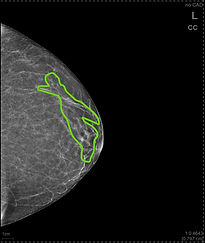
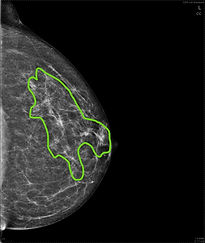
Here are examples of breasts with less white glandular tissue.
These women have NON-DENSE breast tissue. The areas of white are outlined below. You can see that there is less white glandular tissue than on the examples above.



Why does it matter if I have dense breast tissue?
Cancer is white on a mammogram. So if there is a lot of white glandular tissue, then it can be harder to find a white breast cancer. The glandular tissue itself can also increase your risk of getting cancer.
What should I do if I have dense breasts?
Boston Breast Diagnostic Center offers additional imaging exams to help us do a better job of finding breast cancer than just mammography alone.
Option #1
Stick with your mammogram alone. It is the routine imaging done throughout the country.
Option #2
Add an ultrasound to your yearly mammogram. For this option, you would get a mammogram and breast ultrasound every year. Ultrasound finds breast cancer using sound waves. A few more breast cancers are found than having a mammogram alone.
Option #3
Convert your mammogram to a contrast-enhanced mammogram (CEM). This is a once-a-year test that finds breast cancers at a similar rate to breast MRI. Contrast-enhanced mammograms require an intravenous line (IV) in a vein in your arm. Contrast dye goes into the IV line and is used to find breast cancers. We are still getting more information on this but the data looks like CEM finds many more cancers than a mammogram alone. The downside is that it requires an IV line and contrast.
Option #4
Add an MRI to your yearly mammogram. For this option, you would get a mammogram and breast MRI every year. MRI finds breast cancer using a contrast dye, like contrast-enhanced mammography. It creates images using magnetic fields. MRI is mainly used for women who are at high-risk of getting breast cancer. Insurance often does not cover breast MRI just for dense breast tissue.
How do I decide what to do?
Your best bet is to start talking to your primary care physician or gynecologist. They may have some thoughts on which exam is best for you.
You are always welcome to come and talk to the physicians at BBDC as well!